How to Track Your Net Worth in a Spreadsheet
Short answer: List everything you own (cash, investments, property) and everything you owe (cards, loans) on one sheet, then subtract total liabilities from total assets. Update it once a month and watch the number move over time. The trend tells you far more than any single snapshot does.
Net worth is the one number that actually sums up where you stand financially, and a spreadsheet is a perfectly good place to track it. You don’t need a bank connection or a subscription to do this well. Here’s how to set one up and keep it honest month after month.
What is net worth, and why does it matter?
Net worth is just assets minus liabilities. Everything you own, minus everything you owe. It’s not your income, and it’s not your savings account balance on its own. It’s the fuller picture that accounts for both sides of the ledger at once.
- It’s the closest thing to a scoreboard. A rising salary or a fat checking account balance can hide a growing pile of debt sitting right behind it.
- It ties your accounts together. Cash, investments, property, cards, and loans usually live in separate places. Net worth is what happens when you finally put them on one page.
- It rewards paying down debt just as much as saving. Knocking $500 off a credit card moves the number exactly as much as putting $500 into savings.
How do you set up a net worth spreadsheet?
- Create an Accounts tab. Three columns is enough to start: Account, Type, and Balance.
- List every asset. Checking, savings, investment accounts, retirement accounts, and anything else with real value, like a car or a house, if you want to include property.
- List every liability. Credit cards, a car loan, a mortgage, student loans, anything you owe money on. Enter these as negative numbers or keep them in their own column, whichever is easier for you to read at a glance.
- Add two summary cells. One that totals the assets with
SUM, one that totals the liabilities, and a third that subtracts one from the other. That third cell is your net worth. - Add a Month column, or a new row each month. This is the part that turns a static snapshot into something you can actually watch move.
Here’s what a simple version looks like filled in:
| Account | Type | Balance |
|---|---|---|
| Checking account | Asset (cash) | $2,400 |
| Savings account | Asset (cash) | $8,000 |
| Investment account | Asset (investment) | $15,000 |
| Car | Asset (property) | $9,000 |
| Credit card | Liability (debt) | -$1,200 |
| Car loan | Liability (debt) | -$6,500 |
| Student loan | Liability (debt) | -$12,000 |
Total assets come to $34,400, total liabilities come to $19,700, so net worth lands at $14,700 that month.
What should count as an asset, and what shouldn’t?
Cash and investment balances are easy, you just pull the number straight from the account. Property is a little softer. A car depreciates fast, so if you use one, update its value every few months rather than leaving the purchase price sitting there forever. A house is usually worth using a rough market estimate for, updated once or twice a year rather than monthly, since it doesn’t move nearly as fast as a bank balance does.
One thing worth deciding up front: a financed asset, like a car with a loan on it, should probably show up as two separate lines. The car goes in assets at its current value, and the loan goes in liabilities at its remaining balance. That way paying down the loan actually shows up as progress, instead of just canceling out inside one blended number.
How often should you update it?
Monthly is the sweet spot for most people. Update it too often and you’re just watching normal balance noise, a paycheck that landed a day early or a credit card statement that hasn’t closed yet. Update it too rarely and you lose the shape of the trend. Once a month, on a date that’s easy to remember, like the first or the last day, gives you a clean enough read without turning it into a chore.
Why the trend matters more than the number
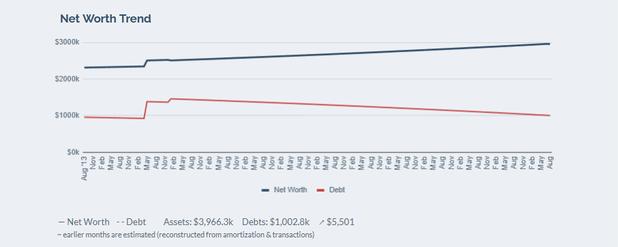
A single net worth figure doesn’t tell you much on its own. Fourteen thousand dollars could be a great result for one person and a rough one for someone else, depending on their age, income, and where they started. What actually matters is the direction it’s moving. A line that climbs steadily, even slowly, means the underlying habits are working. A line that’s flat or sliding is worth a closer look, even if the number itself still looks fine on paper.
This is really the whole point of keeping a running sheet instead of calculating your net worth once and forgetting about it. One number is a fact. A row of numbers over twelve months is a story.
Doing this automatically
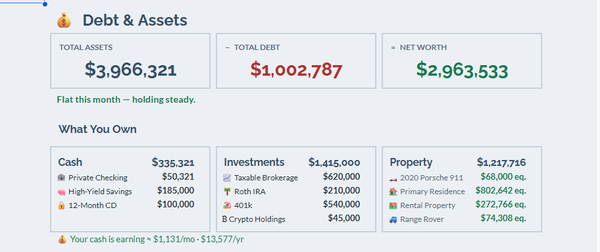
If you’d rather not rebuild this tracker by hand every month, Tolerable Finance is an add-on that runs inside your own Google Sheet. You add your accounts once, cash, investments, property, cards, and loans, and it calculates your net worth and draws the trend line automatically as you import new statements. The debts even get a payoff plan built alongside them, so the liability side of the sheet isn’t just a number sitting there.
Frequently asked questions
What’s a good net worth for my age? There’s no single right answer, since it depends heavily on income, location, and debt like student loans or a mortgage. The more useful question is usually whether your own number is trending up over time, not how it compares to a chart.
Should I include my house or car in net worth? Most people do, valued at a reasonable current estimate rather than the original purchase price. Just remember to list any loan against them as a separate liability, so paying it down actually shows up as progress.
How do I track net worth in Google Sheets specifically?
Build an Accounts tab with columns for Account, Type, and Balance, list your assets and liabilities, and use two SUM formulas plus a subtraction to get your net worth. Add a new row or column each month to build the trend.
Does net worth include retirement accounts? Yes, a 401(k) or IRA balance counts as an asset. Some people track it separately from more liquid accounts since it’s not money you can spend right now, but it still belongs in the overall total.